SessionMenu
For Ubuntu Lucid, the session menu should contain items for locking the session, switching to guest sessions and other user accounts, logging out, sleeping, restarting, and shutting down.
Rationale
The session menu is for when you want to stop using the computer, either temporarily or indefinitely.
The menu’s most prominent items aim for convenient security: locking the session, using a guest session, switching user accounts, and logging out.
The less prominent items are fallbacks for functions that generally have a more visible interface on most computers: Suspend/Hibernate (vs. closing a notebook’s lid), Restart (vs. being prompted when it is actually required), and Shut Down (vs. pressing the power button).
Artwork requirements
- The power icon for the menu title.
- A classy-looking symbol for logged-in user accounts (visually distinct from the normal checkmark for boolean menu items).
Design
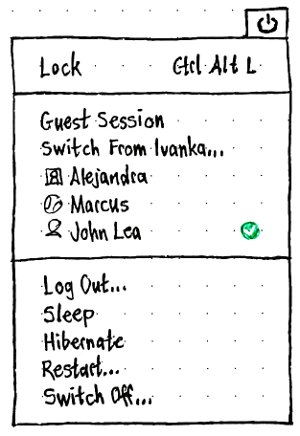
Title
The title of the menu should be a power icon. 
Contents
For the purpose of displaying in the session menu, an account display name consists of the full name (e.g. “Iain Farrell”), unless there is more than one account with that full name, in which case it should be the full name followed by a space and then the login name in brackets (e.g. “Iain Farrell (iain2)”).
The contents of the menu should be, in order:
An item for locking the screen and/or starting the screensaver. If the “desktop/gnome/lockdown/disable_lock_screen” gconf key is true, or if the Screensaver Preferences setting “Lock screen when the screensaver is active” is unchecked, the item should be “Start Screensaver”. Otherwise, it should be “Lock”. (We deliberately do not vary this based on whether the account logs in automatically.)
- A separator.
- “Guest Session”, which switches immediately to the guest session. If the guest session is already in use, there should be a logged-in symbol at the trailing side of the menu. (We must not use a normal checkmark item for this, because that would wrongly suggest we can “turn off” the session merely by deselecting the item.) This item should always be present, but if the session you are using is already a guest one, it should be insensitive. (It is not a security risk for the item to always to be present, because you need to log in to another account before accessing it.)
- “Switch From {your account display name}…”, which locks your session and then displays the login screen. If your account name is wider than 20 em, only the first characters up to 20 em should be displayed, with no extra ellipsis added to the one that is already there. If blocked by your system administrator or unsupported by the computer’s video driver, this item should not be present at all.
Alphabetically sorted items for up to the n user accounts (6 by default, with a gconf key for adjusting it) who were logged in to this system most recently. These items should be present only if (a) the login screen is set to display user accounts, because the same security consideration applies, (b) account switching is supported by the video driver, and (c) account switching is allowed by the system administrator. (Except in the last case, you can still switch to any account, provided you know its name, using the “Switch From…” item.) Each item should consist of:
- At its leading end, the user account icon.
The account display name, ellipsized in the middle if it is wider than 20 em. (Ideally we would use set-based ellipsis instead.)
- At the trailing side of the menu, a logged-in symbol if that account is currently logged in. (For the same reason as for a guest session, we must not use a normal checkmark item here.)
- A separator.
- “Log Out…”, which opens the confirmation alert for logging out.
- “Suspend”, which suspends the computer to memory.
- “Hibernate”, which suspends the computer to disk.
“Restart…”, which opens the confirmation alert for restarting the computer. If software updates that require a restart have been partially installed, this item should instead say “Restart Required…”, and have a
 icon alongside it.
 - “Shut Down…”, which opens the confirmation alert for shutting down.
Fading of background
When the confirmation alert for logging out, restarting, or shutting down is open, the rest of the screen should linearly take 1 second to desaturate completely.
If you click “Cancel”, or if any application interrupts session exit, the desaturation should reverse instantly.
Behavior if you confirm the logout/restart/shutdown is covered by DesktopTeam/Specs/Lucid/ShutdownAndRestartExperience.
Handling upgrades
When first running gnome-panel in a version of Ubuntu that includes the session menu, the top panel (if any) should automatically acquire the session menu at its trailing end.
Future work
- Investigate visual treatments for highlighting menu items in general, so that perhaps the “Restart…” item (and the menu title) could be highlighted when updates require a restart to complete.
Unresolved issues
- Ctrl Alt L is the keyboard equivalent for Lock. This should be shown in the menu.