HelpfulHelp
|
Size: 5829
Comment: + Assumptions + Use case + current state + Breezy suggestions
|
← Revision 28 as of 2008-08-06 16:16:34 ⇥
Size: 15604
Comment: converted to 1.6 markup
|
| Deletions are marked like this. | Additions are marked like this. |
| Line 1: | Line 1: |
| = HelpfulHelp = | = Making Ubuntu Help helpful = |
| Line 3: | Line 3: |
| * Created: [[Date(2005-04-27T09:55:24Z)]] by MartinPool * Priority: NeedsPriority * People: MartinPoolLead, MatthewPaulThomasSecond * Contributors: * Interested: * Status: BrainDump * Branch: * Malone Bug: * Packages: * Depends: * Dependents: [[FullSearch(HelpfulHelp)]] * UduSessions: none |
* '''Launchpad entry:''' https://launchpad.net/distros/ubuntu/+spec/helpful-help * '''Created:''' <<Date(2005-04-27T09:55:24Z)>> by MartinPool * '''Contributors:''' MartinPool, MatthewPaulThomas, JeffWaugh * Packages affected: scrollkeeper, ubuntu-docs, yelp |
| Line 19: | Line 10: |
| Ubuntu needs vast improvement in the quality, targeting, and presentation of its help and documentation ... | Ubuntu offers vast opportunities for improvement in the quality, targeting, and presentation of its help and documentation. For Breezy, code effort should concentrate on adding search and print functions to the help viewer, and writing effort should concentrate on help.ubuntu.com and local help for Ubuntu in general. After Breezy, code effort should go into making help presentation more compact and integrated, and writing effort should go into pushing properly-written help upstream. This informational spec has been split into a number of smaller implementation chunks: * EmbeddedHelp: Encouraging upstream to put useful documentationalistic (!) hints directly in their software. * ImprovingYelp: Iterative improvements to the GNOME help browser. * LinkingDesktopToOnlineHelp: Building a useful relationship between help available within the distro and on the web. * TopicBasedHelp: Splitting help pages into small useful chunks. * ExistingDocumentation: We have a huge amount of documentation we're not exposing to users very well, so we need to fix that. |
| Line 23: | Line 22: |
| Ubuntu is about humanity, and part of humanity is doing our best to avoid confusion and annoyance on the part of people using the system. | Ubuntu is about humanity, and part of humanity is helping people who have lost their way. Providing useful help makes life easier for people MigratingToUbuntu, helping to increase market share. And help that integrates well with external support services could also increase revenue for distributors of Ubuntu and derivative operating systems. |
| Line 30: | Line 29: |
| * may not even have Internet access. | * may not have Internet access. |
| Line 33: | Line 32: |
| * have already installed Ubuntu * are usually looking for a quick answer, not a tutorial * do not want to look in multiple places for their answer * do not care about "books", "chapters", "FAQs", "Doc''''''Book", "yelp", or the "Ubuntu Documentation Project" * will often be frustrated or angry, having spent considerable time trying to solve their problem already * will have accessed the [http://g2meyer.com/usablehelp/lastreso.html help as a last resort], with nearby humans not being knowledgable enough, and Google being either unavailable or not focused enough * will be pessimistic about their chances of the help being helpful. |
* are accessing [[http://g2meyer.com/usablehelp/lastreso.html|help as a last resort]], if nearby humans are not knowledgable enough, and Google is either unavailable or not focused enough * are often frustrated, impatient, and [[http://uie.com/articles/documentation/|pessimistic about the usefulness of the help]] * almost always want to [[http://uie.com/articles/online_information/|search for instructions or explanations]], rather than look at tables of contents, tutorials or overviews * will give up if they reach a dead end, even if the answer might be elsewhere * do not care about "books", "chapters", "FAQs", "Doc''''''Book", "yelp", or the "Ubuntu Documentation Project". |
| Line 42: | Line 39: |
| * will probably read it while following the instructions in the program alongside | * will most likely use it successfully if they can read it while carrying out the instructions in the program alongside |
| Line 47: | Line 44: |
| * Niels is installing Ubuntu for the first time ... | * Niels is installing Ubuntu for the first time, and has no other computers nearby. Fortunately, the colleague who gave him the Ubuntu CD also printed a copy of the installation guide for him. After installation, Niels looks in the "Internet and networking" section of the Ubuntu Help to find out how to get his dialup connection working. |
| Line 49: | Line 46: |
| * Sandra has successfully imported her holiday photos into gThumb, and now she wants to e-mail three of them to her mother. She trawls through gThumb's menus but fails to find anything to do with e-mail. So she opens gThumb's help function and immediately searches for "mail photographs". There are no matching pages in gThumb's help, but the help viewer also returns a result from the general Ubuntu Help about how to e-mail a file to someone (even though this page doesn't use the term "photographs" in its visible text). Following the instructions in this page, Sandra successfully sends the photos, despite the originals being 2 MB each and her mother having a mail quota of 5 MB. | * Sandra has imported her holiday photos into gThumb, and wants to e-mail three of them to her mother. After failing to find this function in the menus, and with no-one nearby to ask, she opens gThumb's help function and searches for "mail photographs". There are no matching pages in gThumb's help, but the help viewer returns a result from the general Ubuntu Help about how to e-mail a file to someone. Following the instructions, Sandra successfully sends the photos. |
| Line 51: | Line 48: |
| * ... | * Claude wants to set up a local Apache server to test Web sites he's developing. He looks in the help for instructions on how to do this. Later, he wants to know how to configure `.htaccess` files; this topic is not covered in the Ubuntu Help, but the help does link to the Apache page on help.ubuntu.com, which in turn links to [[http://httpd.apache.org/docs/howto/htaccess.html|the apache.org page about .htaccess]]. |
| Line 53: | Line 50: |
| * ... | * Tukta needs help using Evolution's calendar. She doesn't like reading help on a computer screen, especially since English is her third language and she is used to Thai translations of help being either non-existent or incomplete. So she is glad to find, at the bottom of Evolution's main help page in Ubuntu, a link to contact details for a paid phone support service. |
| Line 57: | Line 54: |
| From the terminal, manual pages are available with the usual `man` and `apropos` commands -- good if you're wanting to know how to invoke individual programs, and if you're one of the small percentage of people who are comfortable with the terminal (''but see'' CommandLineDisintegration). | From Ubuntu's Terminal program, manual pages are available with the usual `man` and `apropos` commands -- good if you're wanting to know how to invoke individual programs, and if you're one of the small percentage of people who are comfortable with the terminal (''see'' CommandLineDisintegration). |
| Line 59: | Line 56: |
| For most people, their primary access to Ubuntu's help is a program with the unfortunate name "yelp" (a name that appears in the About box and various other places). By default, a button for accessing help appears on the Gnome panel, but it does not look like a button and people may not realize what it is for. Once people do open the help viewer, [http://mpt.net.nz/archive/2005/04/11/ubuntu#help its categorization and contents are quite unhelpful]. In general, it assumes that you already know (a) what program you want to use and (b) where that program fits in the Gnome taxonomy. | For most people, however, their primary access to help is a program with the unfortunate name "yelp". (In theory that name is never visible, but [[http://joelonsoftware.com/articles/LeakyAbstractions.html|in practice]] it is -- in the About box, in the Package Manager, in the System Monitor, and in error messages.) By default, a button for accessing help appears on the Gnome panel, but it does not look like a button and people may not realize what it is for. Once people do open the help viewer, its interface is fairly simple (if a bit too large), but [[http://mpt.net.nz/archive/2005/04/11/ubuntu#help|its categorization and contents are quite unhelpful]]. It assumes that you already know (a) what program you want to use and (b) where that program fits in the Gnome taxonomy, neither of which are usually true. Compounding the problem, there is no search function. |
| Line 61: | Line 58: |
| Most individual programs offer their own help, which is good; but it is usually accessed from a menu item labelled "Contents", which is non-obvious. | Most individual programs offer their own help, which is good; but it is usually hidden in the Help menu as a "Contents" menu item, which is not obvious. Help is written as a set of "books" with "chapters", often taking the form of a depth-first traversal of the interface, rather than actually offering help on likely tasks. Such reference manuals have their place, but that place is [[http://www.useit.com/alertbox/9602.html|in print]], [[http://hcibib.org/tcuid/chap-7.html#7-2|not on a computer screen]]. For example, the screenshots they use are often too large for the help viewer window, and are also [[http://www.google.com/search?q=cache:Ab7nx7LLa3EJ:www.infomanagementcenter.com/enewsletter/200411/secondary.htm+%22even+fairly+sophisticated+users+were+clicking+the+graphic%22|likely to be confused with the actual interface]]. Yelp's interface is also cluttered by the reference manual mindset, with a table of contents and previous/next page links taking up valuable screen space. |
| Line 63: | Line 60: |
| As for the help itself, it is largely written as a set of "books" with "chapters", often taking the form of a depth-first traversal of the interface, rather than actually offering help on likely tasks. Such reference manuals have their place, but it is not on a computer screen. Yelp's interface is also cluttered by the reference manual mindset, with a table of contents and previous+next links taking up valuable screen space. For added fun, Firefox, Gimp, and OpenOffice each use their own help viewer with its own interface design. The Firefox and OpenOffice help viewers are too complex to fit comfortably on one side of a screen while following instructions on the other side, but they have the advantage of offering a working search function. Gimp's help viewer is more compact than yelp, but is nevertheless harder to use. |
Firefox, Open''''''Office, and Gimp use their own help viewers with inconsistent interface designs. The [[http://www.mozilla.org/projects/help-viewer/|Firefox]] and Open''''''Office help viewers are too complex to fit comfortably alongside the program they're providing help on, but they have the advantage of offering a working search function. Gimp's help viewer is more compact than yelp, but is nevertheless harder to use. None of these help systems have adequate integration between the help viewer, the software it is providing help on, and other sources of support. However, programs can launch the help viewer at a particular page, and Firefox's front help page links to online support resources. |
| Line 69: | Line 64: |
| * Give a '''brief''' summary of what the program is about and how to do the task they seem to be trying to do at the moment. | Ideally, the process of helping people use software should be an integration of the software itself, the help viewer, the Web, and paid support services. |
| Line 71: | Line 66: |
| * Take them through some trouble-shooting questions if they seem to be having trouble. | {{attachment:helpsystem.jpg}} |
| Line 73: | Line 68: |
| * Link in to the support/bug reporting system. | === Embedded help === |
| Line 75: | Line 70: |
| See also AutomatedProblemReports. | Help writers should be active in reporting bugs which, when fixed, allow a help document to become simpler or to concentrate on likely problems rather than on basic use. Since people other than [[http://ui.netbeans.org/usability/Mar_20_02/#help|programmers]] are [[http://tc.eserver.org/10347.html|highly reluctant to use anything in the Help menu]], software authors should be encouraged to add help tips (including explanations of why controls are unavailable), hints and examples for form elements, and other [[http://klariti.com/technical-writing/Improve-Usability-Embedded-Help.shtml|embedded help]] in dialogs and rarely-used windows. |
| Line 77: | Line 72: |
| == Random notes == | === The help viewer === |
| Line 79: | Line 74: |
| * See for example [http://blogs.msdn.com/jonathanh/archive/2005/04/11/407484.aspx this post about web search vs online help in MS Office]. | The help viewer should be, by default, compact enough to fit comfortably alongside the program it is providing help on. It should be easily searchable, with results being returned despite misspellings and use of synonyms, and results from the general Ubuntu Help being grouped underneath results for the current program. Programs should be able to tell the help viewer to search for particular words, a less fragile alternative to linking to individual pages. |
| Line 81: | Line 76: |
| * When an error message is shown, there is a link to help with troubleshooting information and a place to submit a support request/bug. | The help itself should concentrate on giving people step-by-step instructions on how to achieve things and how to solve problems. Where appropriate, a help page should end with a list of links to related pages or well-crafted searches. (These links themselves should not be indexed for the search function.) As part of the teaching process, the help viewer should be able to tell GTK to highlight an element in a program's window by drawing a translucent ring around it. |
| Line 83: | Line 78: |
| * http://ubuntu.com/wiki/DocteamProjects | ''Comparisons:'' * [[http://knabedesign.com/articles/applehelp/applehelp.html|''Designing Apple Help'' by Kevin Knabe]] * [[http://www.xvsxp.com/help/|Comparison of help viewers in Windows XP and Mac OS X]] * [[http://help-info.de/en/Help_Info_Longhorn/longhorn_help_pane.htm|Preview of Windows "Longhorn" help viewer]] * [[http://g2meyer.com/usablehelp/gallery/|Gallery of modern help systems]] |
| Line 85: | Line 84: |
| == Implementation == | === Web integration === |
| Line 87: | Line 86: |
| === Breezy suggestions === | People experienced with Ubuntu can, and do, post help and suggestions to Web forums and wikis. While upstream help is in its current state, such DIY documentation will often answer questions in non-developer language better than most help files do. Online documentation can also be updated more easily than packaged help, and can continue to be updated after an Ubuntu release. |
| Line 89: | Line 88: |
| ''These are not confirmed bounties, only suggestions. If you're looking for a bounty, come back when this spec has reached Approved status.'' | Because people are very likely to just give up if they do not find the answer on the first path they follow, the help viewer should integrate as smoothly as possible with help.ubuntu.com and paid support services. This can be done as follows. |
| Line 91: | Line 90: |
| 1. Write some general help for Ubuntu following the assumptions above (''see'' [http://ubuntu.com/wiki/LocalHelp LocalHelp]). 1. A bounty to add search to yelp. 1. Rename yelp to HelpViewer or some other human-understandable name. 1. A bounty to get Gimp help displaying in HelpViewer. 1. Investigate feasibility of a print function. |
* A distinct but unobtrusive link at the bottom for "Get more help online" should be present at the bottom of all search results, and at the bottom of all pages except those that explicitly opt out. In Ubuntu, this link should open a Web browser to search help.ubuntu.com for pages containing the same search terms (for search results) and/or the page title (for a help page). The link should never break as long as help.ubuntu.com exists, regardless of what CMS it is using in a given year. The link should be greyed out with an explanation if the network is offline (''see'' NetworkMagic). |
| Line 97: | Line 92: |
| === Data preservation and migration === | * Distributors may choose to add a further link to the bottom of each page, such as "Get support from ''name-of-company''". They may also customize the "Getting more help" page. |
| Line 99: | Line 94: |
| === Packages Affected === | ''Comparison:'' * [[http://www.helpware.net/longhorn/review1b.htm#No_Dead_Ends|Windows Longhorn's "Assistance Escalation Path"]] |
| Line 101: | Line 97: |
| * scrollkeeper * ubuntu-docs * yelp |
=== help.ubuntu.com === |
| Line 105: | Line 99: |
| == Outstanding issues == | Many people will search the Web for answers without even looking at the packaged help. While the help viewer's search function remains either non-existent or primitive, the Web may even produce better results, because search engines recognize synonyms and misspellings more thoroughly than the help does. These people should be catered for by making help.ubuntu.com a superset of the packaged help, rather than a partially intersecting set. help.ubuntu.com should have a slight bias towards information that may change from month to month (such as how to install support for [[https://wiki.ubuntu.com/RestrictedFormats|RestrictedFormats]]), while the packaged help should have a slight bias towards information on how to connect to the Internet or use programs offline. Like the packaged help, online help should be [[http://www.useit.com/alertbox/9710a.html|well-written]] and task-centered, though on the Web there is more scope for tutorials and overview documents. help.ubuntu.com should also provide links to Web forums and IRC channels, with advice on how to use them; and offer tips on how to search the Web for error messages, file good bug reports, and so on. Like the packaged help, help.ubuntu.com should automatically display in your preferred language, with help being written in parallel in multiple languages. For example, if you are using Ubuntu in Xhosa, the help viewer should link to the Xhosa area of help.ubuntu.com, which in turn should link to Xhosa Web forums if they exist. ''Comparisons:'' * [[http://codex.wordpress.org/Main_Page|WordPress Codex]] * [[http://blogs.msdn.com/jonathanh/archive/2005/04/11/407484.aspx|Web search vs. online help in MS Office]] * [[http://en.wikipedia.org/wiki/Wikipedia:Multilingual_coordination|Wikipedia: Multilingual coordination]] == Future work == In approximate order of importance: * Implement the opt-out supplemental links for help pages as described [[#head-a3fcc4ba5d6fd2d12cc7ef1d54644adf416d1a85|above]]. As a useful example of the feature, link to a context-sensitive search of help.ubuntu.com from all pages except the front page, the "Getting more help" page, and the pages about connecting to the Internet. * Hide or remove the table of contents frame and the previous/next links from the help viewer, making the default window size smaller to match. * Make the help viewer toolbar icons-only, regardless of the "Menus & Toolbars" setting. * Add index-based spelling suggestions to the search function. * Get Open''''''Office to use the standard help viewer. * Get Gimp to use the standard help viewer. * Get Firefox to use the standard help viewer. * Implement highlighting of controls (requires XOrg Composite + Damage). * Begin writing useful help for programs in `main` and push it upstream. * Begin [[http://uie.com/articles/documentation_help/|usability testing]] of existing help. == See also == * AutomatedProblemReports * [[http://ubuntu.com/wiki/DocteamProjects|Current Ubuntu Documentation Team projects]] == Discussion == * LunaTick : I am sure that this must have been discussed somewhere but, as I can't find it, I will throw this idea down. If anyone knows where it should be, feel free to move it. I would love to see Launchpad absorb the management of help for programs. I should be able to go to the "Get Help Online" page and read the latest version of the help and make edits if I spot mistakes or make additions (these would be moderated). These should automatically create offline versions to be pushed upstream and form the basis of man pages and the help through the help menu. If it was all handled in Launchpad, it would be relatively easy to feed the help into the translation section. Currently contributing to Help files is a relatively difficult task for non-programmers (AFAICS), yet it is often non-programmers that can best communicate with the masses. The online help could be divided into the 'official' part that formed the offline help, was translated etc. and a 'comments' section where other users could post links and advice in a more casual manner. Again, I apologise if this is not where this should have gone. ---- CategorySpec CategoryDocteam |
Making Ubuntu Help helpful
Launchpad entry: https://launchpad.net/distros/ubuntu/+spec/helpful-help
Created: 2005-04-27 by MartinPool
Contributors: MartinPool, MatthewPaulThomas, JeffWaugh
- Packages affected: scrollkeeper, ubuntu-docs, yelp
Summary
Ubuntu offers vast opportunities for improvement in the quality, targeting, and presentation of its help and documentation. For Breezy, code effort should concentrate on adding search and print functions to the help viewer, and writing effort should concentrate on help.ubuntu.com and local help for Ubuntu in general. After Breezy, code effort should go into making help presentation more compact and integrated, and writing effort should go into pushing properly-written help upstream.
This informational spec has been split into a number of smaller implementation chunks:
EmbeddedHelp: Encouraging upstream to put useful documentationalistic
 hints directly in their software.
 ImprovingYelp: Iterative improvements to the GNOME help browser.
LinkingDesktopToOnlineHelp: Building a useful relationship between help available within the distro and on the web.
TopicBasedHelp: Splitting help pages into small useful chunks.
ExistingDocumentation: We have a huge amount of documentation we're not exposing to users very well, so we need to fix that.
Rationale
Ubuntu is about humanity, and part of humanity is helping people who have lost their way. Providing useful help makes life easier for people MigratingToUbuntu, helping to increase market share. And help that integrates well with external support services could also increase revenue for distributors of Ubuntu and derivative operating systems.
Assumptions
When someone is installing or troubleshooting Ubuntu, they:
- probably don't have another computer available
- don't have the ability to run other programs on the same computer
- may not have Internet access.
When someone is looking for help within Ubuntu, they:
are accessing help as a last resort, if nearby humans are not knowledgable enough, and Google is either unavailable or not focused enough
are often frustrated, impatient, and pessimistic about the usefulness of the help
almost always want to search for instructions or explanations, rather than look at tables of contents, tutorials or overviews
- will give up if they reach a dead end, even if the answer might be elsewhere
do not care about "books", "chapters", "FAQs", "DocBook", "yelp", or the "Ubuntu Documentation Project".
If people find the help they need, they:
- will most likely use it successfully if they can read it while carrying out the instructions in the program alongside
- may want to print it out for easier study.
Use cases
- Niels is installing Ubuntu for the first time, and has no other computers nearby. Fortunately, the colleague who gave him the Ubuntu CD also printed a copy of the installation guide for him. After installation, Niels looks in the "Internet and networking" section of the Ubuntu Help to find out how to get his dialup connection working.
- Sandra has imported her holiday photos into gThumb, and wants to e-mail three of them to her mother. After failing to find this function in the menus, and with no-one nearby to ask, she opens gThumb's help function and searches for "mail photographs". There are no matching pages in gThumb's help, but the help viewer returns a result from the general Ubuntu Help about how to e-mail a file to someone. Following the instructions, Sandra successfully sends the photos.
Claude wants to set up a local Apache server to test Web sites he's developing. He looks in the help for instructions on how to do this. Later, he wants to know how to configure .htaccess files; this topic is not covered in the Ubuntu Help, but the help does link to the Apache page on help.ubuntu.com, which in turn links to the apache.org page about .htaccess.
- Tukta needs help using Evolution's calendar. She doesn't like reading help on a computer screen, especially since English is her third language and she is used to Thai translations of help being either non-existent or incomplete. So she is glad to find, at the bottom of Evolution's main help page in Ubuntu, a link to contact details for a paid phone support service.
State of the help in Ubuntu 5.04
From Ubuntu's Terminal program, manual pages are available with the usual man and apropos commands -- good if you're wanting to know how to invoke individual programs, and if you're one of the small percentage of people who are comfortable with the terminal (see CommandLineDisintegration).
For most people, however, their primary access to help is a program with the unfortunate name "yelp". (In theory that name is never visible, but in practice it is -- in the About box, in the Package Manager, in the System Monitor, and in error messages.) By default, a button for accessing help appears on the Gnome panel, but it does not look like a button and people may not realize what it is for. Once people do open the help viewer, its interface is fairly simple (if a bit too large), but its categorization and contents are quite unhelpful. It assumes that you already know (a) what program you want to use and (b) where that program fits in the Gnome taxonomy, neither of which are usually true. Compounding the problem, there is no search function.
Most individual programs offer their own help, which is good; but it is usually hidden in the Help menu as a "Contents" menu item, which is not obvious. Help is written as a set of "books" with "chapters", often taking the form of a depth-first traversal of the interface, rather than actually offering help on likely tasks. Such reference manuals have their place, but that place is in print, not on a computer screen. For example, the screenshots they use are often too large for the help viewer window, and are also likely to be confused with the actual interface. Yelp's interface is also cluttered by the reference manual mindset, with a table of contents and previous/next page links taking up valuable screen space.
Firefox, OpenOffice, and Gimp use their own help viewers with inconsistent interface designs. The Firefox and OpenOffice help viewers are too complex to fit comfortably alongside the program they're providing help on, but they have the advantage of offering a working search function. Gimp's help viewer is more compact than yelp, but is nevertheless harder to use. None of these help systems have adequate integration between the help viewer, the software it is providing help on, and other sources of support. However, programs can launch the help viewer at a particular page, and Firefox's front help page links to online support resources.
How help should work
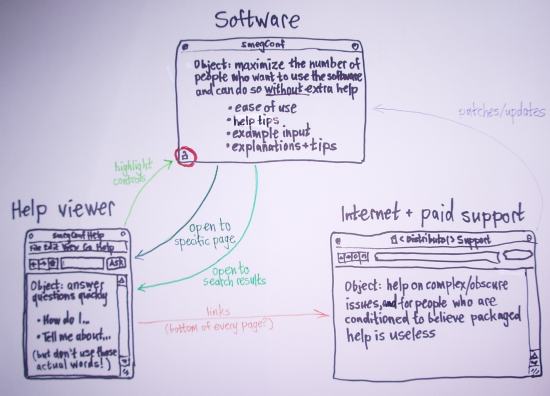
Ideally, the process of helping people use software should be an integration of the software itself, the help viewer, the Web, and paid support services.
Embedded help
Help writers should be active in reporting bugs which, when fixed, allow a help document to become simpler or to concentrate on likely problems rather than on basic use. Since people other than programmers are highly reluctant to use anything in the Help menu, software authors should be encouraged to add help tips (including explanations of why controls are unavailable), hints and examples for form elements, and other embedded help in dialogs and rarely-used windows.
The help viewer
The help viewer should be, by default, compact enough to fit comfortably alongside the program it is providing help on. It should be easily searchable, with results being returned despite misspellings and use of synonyms, and results from the general Ubuntu Help being grouped underneath results for the current program. Programs should be able to tell the help viewer to search for particular words, a less fragile alternative to linking to individual pages.
The help itself should concentrate on giving people step-by-step instructions on how to achieve things and how to solve problems. Where appropriate, a help page should end with a list of links to related pages or well-crafted searches. (These links themselves should not be indexed for the search function.) As part of the teaching process, the help viewer should be able to tell GTK to highlight an element in a program's window by drawing a translucent ring around it.
Comparisons:
Web integration
People experienced with Ubuntu can, and do, post help and suggestions to Web forums and wikis. While upstream help is in its current state, such DIY documentation will often answer questions in non-developer language better than most help files do. Online documentation can also be updated more easily than packaged help, and can continue to be updated after an Ubuntu release.
Because people are very likely to just give up if they do not find the answer on the first path they follow, the help viewer should integrate as smoothly as possible with help.ubuntu.com and paid support services. This can be done as follows.
A distinct but unobtrusive link at the bottom for "Get more help online" should be present at the bottom of all search results, and at the bottom of all pages except those that explicitly opt out. In Ubuntu, this link should open a Web browser to search help.ubuntu.com for pages containing the same search terms (for search results) and/or the page title (for a help page). The link should never break as long as help.ubuntu.com exists, regardless of what CMS it is using in a given year. The link should be greyed out with an explanation if the network is offline (see NetworkMagic).
Distributors may choose to add a further link to the bottom of each page, such as "Get support from name-of-company". They may also customize the "Getting more help" page.
Comparison:
help.ubuntu.com
Many people will search the Web for answers without even looking at the packaged help. While the help viewer's search function remains either non-existent or primitive, the Web may even produce better results, because search engines recognize synonyms and misspellings more thoroughly than the help does.
These people should be catered for by making help.ubuntu.com a superset of the packaged help, rather than a partially intersecting set. help.ubuntu.com should have a slight bias towards information that may change from month to month (such as how to install support for RestrictedFormats), while the packaged help should have a slight bias towards information on how to connect to the Internet or use programs offline.
Like the packaged help, online help should be well-written and task-centered, though on the Web there is more scope for tutorials and overview documents. help.ubuntu.com should also provide links to Web forums and IRC channels, with advice on how to use them; and offer tips on how to search the Web for error messages, file good bug reports, and so on.
Like the packaged help, help.ubuntu.com should automatically display in your preferred language, with help being written in parallel in multiple languages. For example, if you are using Ubuntu in Xhosa, the help viewer should link to the Xhosa area of help.ubuntu.com, which in turn should link to Xhosa Web forums if they exist.
Comparisons:
Future work
In approximate order of importance:
Implement the opt-out supplemental links for help pages as described above. As a useful example of the feature, link to a context-sensitive search of help.ubuntu.com from all pages except the front page, the "Getting more help" page, and the pages about connecting to the Internet.
- Hide or remove the table of contents frame and the previous/next links from the help viewer, making the default window size smaller to match.
Make the help viewer toolbar icons-only, regardless of the "Menus & Toolbars" setting.
- Add index-based spelling suggestions to the search function.
Get OpenOffice to use the standard help viewer.
- Get Gimp to use the standard help viewer.
- Get Firefox to use the standard help viewer.
- Implement highlighting of controls (requires XOrg Composite + Damage).
Begin writing useful help for programs in main and push it upstream.
Begin usability testing of existing help.
See also
Discussion
LunaTick : I am sure that this must have been discussed somewhere but, as I can't find it, I will throw this idea down. If anyone knows where it should be, feel free to move it. I would love to see Launchpad absorb the management of help for programs. I should be able to go to the "Get Help Online" page and read the latest version of the help and make edits if I spot mistakes or make additions (these would be moderated). These should automatically create offline versions to be pushed upstream and form the basis of man pages and the help through the help menu. If it was all handled in Launchpad, it would be relatively easy to feed the help into the translation section. Currently contributing to Help files is a relatively difficult task for non-programmers (AFAICS), yet it is often non-programmers that can best communicate with the masses. The online help could be divided into the 'official' part that formed the offline help, was translated etc. and a 'comments' section where other users could post links and advice in a more casual manner. Again, I apologise if this is not where this should have gone.
HelpfulHelp (last edited 2008-08-06 16:16:34 by localhost)